







One URL is checked as a visible entry point: page identity, SEO foundation, GEO signals, source work and concrete findings.
Mundus checks whether ChatGPT, Claude, Perplexity and Google AI can read your website as a source — and the report shows what is missing, what it affects and what to fix first.
GEO + SEO AUDIT ENGINE
A quick overview of product, measurement logic, modules, pricing and report output. Each point jumps directly to the matching section.
Mundus says: GEO does not run beside SEO; it runs on the same technical and semantic foundation.
When generative search arrived, the industry quickly had an advertising slogan: SEO was over, only GEO mattered now. It sold well — and measured poorly.
Field data shows a different picture. AI answer systems cite pages that are crawlable, cleanly structured and verifiable as sources — exactly the foundation good SEO work has been building for years. Recent data analyses on generative search from Google and Ahrefs confirm the same: the classical search layer and the answer layer work on the same base.
Sources: Google Search Central — Gen-AI Performance Reports (06/2026) Ahrefs — AIO-Datenstudie (55,8 Mio. AI Overviews)
That is why Mundus is deliberately built on both levels: the signal inventory measures classical SEO signals like meta architecture, headings and internal linking in the same report as entity clarity, citation evidence and agent readiness. One layer carries the other.
Mundus measures the first three stations directly and checks the fourth with citation evidence from real AI answers.
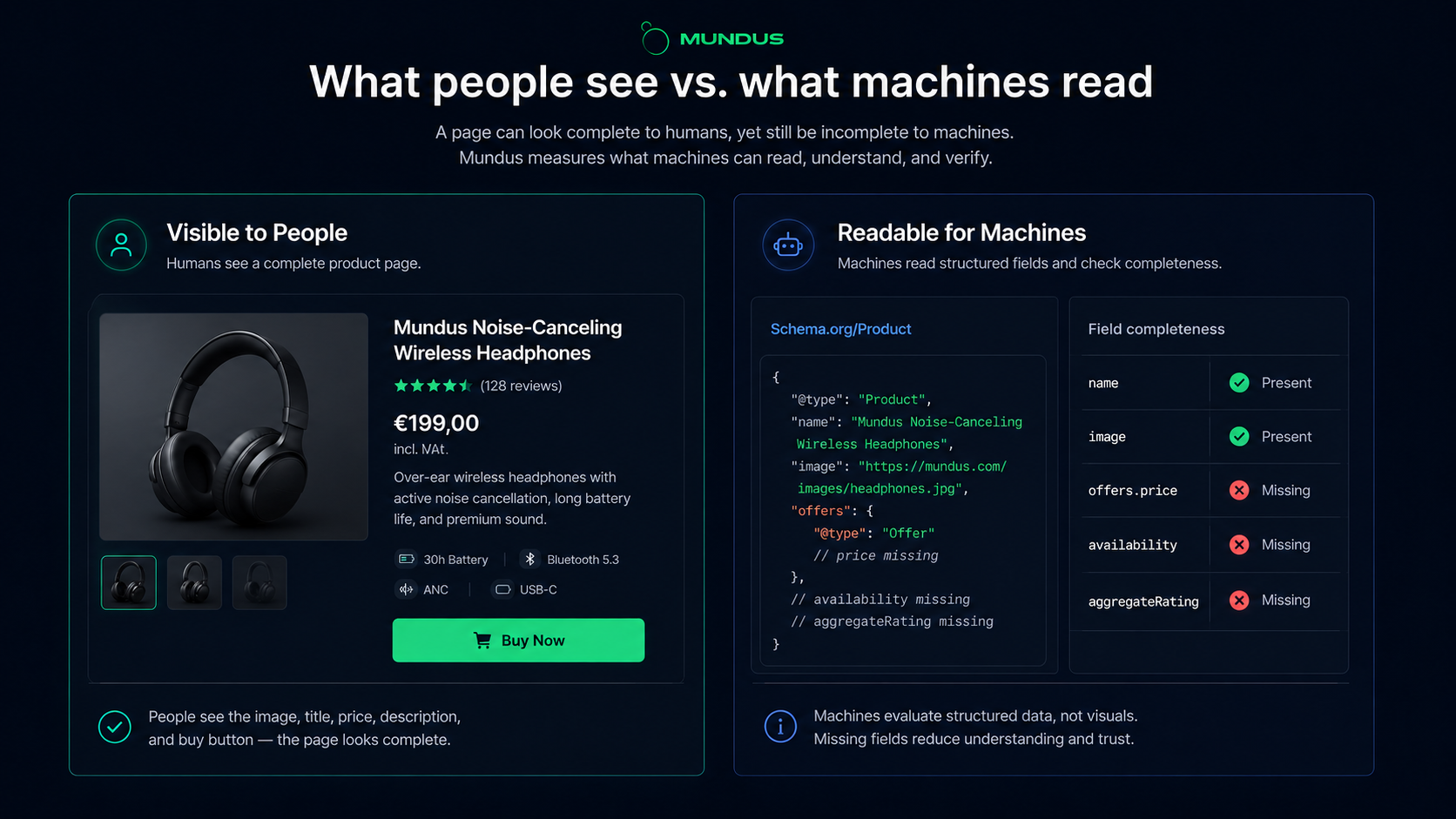
Mundus says: a page must not only look good to people, but be readable by machines as a reliable source.
When someone asks ChatGPT about a product or a supplier, the prettiest text does not decide who gets named — the pages the machine can safely read, classify and verify do. That is exactly what Mundus measures: whether a website can be read as a reliable source by ChatGPT, Perplexity, Google AI Overview and classical search systems, through measurable visibility signals like crawl access, entity clarity, schema, citation evidence and lead paths.
The core is deterministic: metrics are repeatedly tested against real pages, real crawl paths and reproducible thresholds. Where AI systems tend to hallucinate, Mundus works with evidence, evidence boundaries and rerunnable measurement.
Mundus is not a single score, but four products with the same report principle. The entry point follows the question: one specific URL, a whole shop, a single module or month-to-month movement. Every product ends in a readable report with evidence, findings and the next work step.
One URL is checked as a visible entry point: page identity, SEO foundation, GEO signals, source work and concrete findings.
The complete audit across Page Visibility, Crawl Inventory, Catalog Deep Dive and AI Journey. The main report for shops and commerce structures.
Citation, Benchmark, AEO and Prompt Discovery can run alone or combined without starting the whole Full Audit every time.
Stored scans become movement: score delta, new issues, lost strengths and monthly actions for repeatable GEO steering.
Every finding gets a measurable role: crawl boundary, URL architecture, SEO foundation, commerce template, AI journey, citation evidence and validation. The engines keep changing — the inventory is tracked against real scans: new measurement points are added, thresholds are recalibrated.
Inventory status: June 2026 · continuously extendedMundus includes the four most important measurement and analysis metrics in GEO: Sector Benchmark, AI Citation, Prompt Discovery and AEO Audit — you get them under the Modules option. Each module answers one question with measured data instead of generic advice — where you stand, whether AI cites you, what your market is actually asking, and whether an AI assistant can act on your site. Run them inside the Full Audit or standalone.
Is 65 out of 100 strong or weak? It depends entirely on your sector.
The AI mentions your brand. But does it cite you as the source?
Your customer doesn't type keywords into ChatGPT. They ask a full question.
Your site is built for Google's crawler. But can an AI assistant act on it?
Run the four modules inside a Full AI Visibility Audit or standalone — each one returns measured evidence, findings and the next work step.
See products & pricingMundus says: this is a real scan, not a mockup — the full report is downloadable below in three languages.
The complete HTML reports open in a new tab.
For agencies that need to deliver checkable reports, not only explain what GEO is: catalog, product pages, category context, schema, lead paths and citation evidence.
Agenturen →For companies and operators that want to control AI visibility themselves. Mundus shows not only a score, but where measured evidence is strong, weak or not yet reliable.
For marketing and e-commerce teams that need to track monthly movement, new issues and closed gaps. The report becomes a measurement point, not a presentation.
Mundus sells access through scan credits. The rule is simple: one scan uses one credit — no matter which product runs. Billing stays as readable as the report.
One URL is checked with 10 deterministic fetch+parse signals and 1 live Perplexity spot check for the selected target market. No full multi-platform citation, benchmark, OpenAI, SerpApi or Google AI Overview measurement runs in the free scan.
A single Full AI Visibility Audit scan without monthly access. Useful when the first need is one complete report for a domain.
The monthly access includes 5 credits. Every scan uses 1 credit, regardless of whether Page Visibility, Full Audit, Modules or Monitoring is run.
One credit becomes a complete evidence report, not a single score: a full crawl, deterministic SEO/GEO/E-E-A-T/AEO values you can reconstruct line by line, the chosen add-ons, and a prioritized fix list. Because the core is deterministic, you can act and re-measure the same page to see what moved.
An account keeps credits, reports and saved scans together. The first run can be a single URL, a full audit or a module bundle — the contract stays the same: one scan, one credit, one report.
The boundary between measured, unmeasured, fetch-failed, no-fetch, visible and machine-readable evidence.
Mention means the brand appears. Citation means the domain is used as a source.
The share of tested AI answers where a domain becomes visible in the relevant question set.
Contact, services, lead paths, action schema and freshness must be readable enough for answer systems to use reliably.
If app access is not active yet or a team setup needs preparation, a short note with domain, target market and product question is enough.
A short message is enough: domain, target market, question.